
Hello folks,
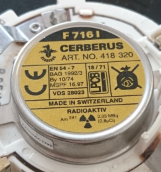
I recently purchased a CZT detector from ebay. Its marked
"EV products, B1829 - Division of II-VI Incorporated"
I only found this data about it
https://www.kephis.com/kephis/czt.htm
Providing schematic and details, but no information about the "HV" voltage that needs to applied. Various sites have values for CZT from 30 up to 1kV but i'm not in the mood to damage my detector by just apply any voltage to it...
Has anyone here ever seen this detector or knows what voltage to apply ?
CZT Detector help
CZT Detector help
- Jonathan from Switzerland
Re: CZT Detector help
Hello
I have a similar detector from the same source since quite a while but never got the time to build a readout for it. So I never recorded a spectrum (still on my to do list though). But I tested it starting at 0V and increased voltage until I saw pulses. They started coming at around 90V. I believe that in order to get the full resolution the voltage should be higher. But I would want to see a spectrum first, and then play around with the HV to optimize resolution.
In general I believe these detectors are similar to HPGe in that the HV should ramp up slowly.
Best regards
Michael
I have a similar detector from the same source since quite a while but never got the time to build a readout for it. So I never recorded a spectrum (still on my to do list though). But I tested it starting at 0V and increased voltage until I saw pulses. They started coming at around 90V. I believe that in order to get the full resolution the voltage should be higher. But I would want to see a spectrum first, and then play around with the HV to optimize resolution.
In general I believe these detectors are similar to HPGe in that the HV should ramp up slowly.
Best regards
Michael
Michael Reese
Darmstadt Germany
Darmstadt Germany
Re: CZT Detector help
Hi Jonathan,
These detectors will work already around 60 V, best is to connect the output to an oscilloscope and watch the pulses coming out if you raise the voltage to high you can see the noise getting stronger.
So that gives you a good indication that you are at the breaking voltage of the crystal try an as low as possible voltage, so the noise stay is low as possible.
Detection with these detectors is interesting but if you connect it to an mca you will see a relative long tail on the peaks but that is just the way they works.
You can have a nice resolution special with lower energies because the crystal is relative small.
Luuk
These detectors will work already around 60 V, best is to connect the output to an oscilloscope and watch the pulses coming out if you raise the voltage to high you can see the noise getting stronger.
So that gives you a good indication that you are at the breaking voltage of the crystal try an as low as possible voltage, so the noise stay is low as possible.
Detection with these detectors is interesting but if you connect it to an mca you will see a relative long tail on the peaks but that is just the way they works.
You can have a nice resolution special with lower energies because the crystal is relative small.
Luuk
-
Sesselmann

- Posts: 1374
- Joined: 27 Apr 2015, 11:40
- Location: Sydney
- Contact:
Re: CZT Detector help
Jonathan,
There have been quite a few of those eV-CZT detector floating around on eBay, several years ago i recorded this spectrum with one.
https://www.gammaspectacular.com/image/ ... 3Ba(2).jpg
Luuk is in the ballpark, I recall running these at around 70V using the GS-1100A with a simple 10:1 voltage divider. The only problem with those detectors is that they are microphonic, so they pick up any sound in the room. providing the frequency of the sound is low, PRA corrects for the baseline shift, but it's a problem you might run into.
Steven
There have been quite a few of those eV-CZT detector floating around on eBay, several years ago i recorded this spectrum with one.
https://www.gammaspectacular.com/image/ ... 3Ba(2).jpg
Luuk is in the ballpark, I recall running these at around 70V using the GS-1100A with a simple 10:1 voltage divider. The only problem with those detectors is that they are microphonic, so they pick up any sound in the room. providing the frequency of the sound is low, PRA corrects for the baseline shift, but it's a problem you might run into.
Steven
Steven Sesselmann | Sydney | Australia | https://gammaspectacular.com | https://beejewel.com.au | https://www.researchgate.net/profile/Steven-Sesselmann
Info for eV CZT brick detector
Hi everybody.
I bought one eV (now Kromek) brick detector from "Kephis" ebay store long ago (2015), recently I was thinking to save the info for using it but the only source for a detailed schematic (kephis website) that is listed in this forum nowdays has broken links.
Kromek isn't so open of sharing the information about their old products.
Luckily I found out that I actually saved some info at the time of the purchase, so I'd like to share it in case anyone will need in the future.
I also found that the eV brick detector is used in the "Exploranium" GR135 portable isotope identifier together with a NaI miniature scintillator and a small Geiger-Muller tube.
I bought one eV (now Kromek) brick detector from "Kephis" ebay store long ago (2015), recently I was thinking to save the info for using it but the only source for a detailed schematic (kephis website) that is listed in this forum nowdays has broken links.
Kromek isn't so open of sharing the information about their old products.
Luckily I found out that I actually saved some info at the time of the purchase, so I'd like to share it in case anyone will need in the future.
I also found that the eV brick detector is used in the "Exploranium" GR135 portable isotope identifier together with a NaI miniature scintillator and a small Geiger-Muller tube.
-
Sesselmann
- Posts: 1374
- Joined: 27 Apr 2015, 11:40
- Location: Sydney
- Contact:
Re: CZT Detector help
"ziouranio"
Thanks for posting. I recall buying quite a few of these CZT detectors on ebay around the same time. I sold some and gave away others (now regret).
By the way, please give yourself a formal intro in this forum, so we can all know you better.
https://www.gammaspectacular.com/phpBB3 ... um.php?f=2
Thanks..
Steven
Thanks for posting. I recall buying quite a few of these CZT detectors on ebay around the same time. I sold some and gave away others (now regret).
By the way, please give yourself a formal intro in this forum, so we can all know you better.
https://www.gammaspectacular.com/phpBB3 ... um.php?f=2
Thanks..
Steven
Steven Sesselmann | Sydney | Australia | https://gammaspectacular.com | https://beejewel.com.au | https://www.researchgate.net/profile/Steven-Sesselmann
-
Rob Tayloe
- Posts: 175
- Joined: 10 Nov 2020, 12:00
- Contact:
Re: CZT Detector help
When these small CZT detectors showed up on ebay a few years back, I obtained a few. As I recall Steven Sesselmann did quite a bit of work to identify various bits inside the device. The folks at eV Products involved in this project seemed to have been long departed and there was scant documentation. I discovered that I was capable of rendering a device fully non-operable as some bits were somewhat delicate.
More recently I saw one of these devices for sale on ebay with cables attached to provide power and obtain a signal. I purchased this device and found that it works as well as one might expect from a small CZT detector. But it does work and with patience a spectrum can be obtained. The guy that I purchased the detector from is Dr. Max Fomitchev-Zamilov; his website is http://maximus.energy/. There are some interesting blogs about radiation measurements on his website.
I have some photos that give more info. The detector uses a 9 volt battery to power the pre-amp. There is an SHV connector for high voltage; I found 850 volts worked ok with my Spectrum Techniques UCS30 MCA. There is also a BNC connector for the signal; I needed a gender changer to use a longer cable. I did not shield the detector and source, nor did I count for a very long time. Never-the-less one can see the spectrum for Cs-137. This is similar in appearance that I've observed with other CZT detectors.
More recently I saw one of these devices for sale on ebay with cables attached to provide power and obtain a signal. I purchased this device and found that it works as well as one might expect from a small CZT detector. But it does work and with patience a spectrum can be obtained. The guy that I purchased the detector from is Dr. Max Fomitchev-Zamilov; his website is http://maximus.energy/. There are some interesting blogs about radiation measurements on his website.
I have some photos that give more info. The detector uses a 9 volt battery to power the pre-amp. There is an SHV connector for high voltage; I found 850 volts worked ok with my Spectrum Techniques UCS30 MCA. There is also a BNC connector for the signal; I needed a gender changer to use a longer cable. I did not shield the detector and source, nor did I count for a very long time. Never-the-less one can see the spectrum for Cs-137. This is similar in appearance that I've observed with other CZT detectors.
- Attachments
-
- 07czt.jpg (94.71 KiB) Viewed 7584 times
-
-
-
-
-
-
-
- eV CZT detector from ebay.
Who is online
Users browsing this forum: No registered users and 29 guests

