
Hey guys,
I just built a new detector using Hamamatsu R980 PMT and a Russian NaI(Tl) 1.5" x 3.1" (40mm x 80mm) and the result seems to be quite good.
A detailed description of the build process is posted on my blog - http://blog.kotarak.net/2020/11/buildin ... gamma.html
Any comments and feedback is highly appreciated.
I still need to tune the setup - my GS-USB-PRO is currently tuned for the GS-1525 detector and I didn't want to play with the Pulse Shape pot - the pulses coming from the new detector seems to be a tad shorter and the volume needs to be adjusted, but the resolution I am getting as qucik-n-dirty test @662keV is 6.9%
Best,
Newly built detector with Hamamatsu R980 and 1.5 x 3.1 NaI(Tl)
-
kotarak
- Posts: 65
- Joined: 07 May 2020, 05:46
-
GigaBecquerel
- Posts: 172
- Joined: 04 Jul 2020, 07:34
Re: Newly built detector with Hamamatsu R980 and 1.5 x 3.1 NaI(Tl)
Very nice, I like your build!
My only critic is that usually you want a PMT with an active photocathode area that's at least as big as the scintillator itself.
If you can't ensure that you could wrap it all in PTFE tape to increase the photon collection efficiency, this might get you up (or down?) to 6.5% I think.
Lukas
My only critic is that usually you want a PMT with an active photocathode area that's at least as big as the scintillator itself.
If you can't ensure that you could wrap it all in PTFE tape to increase the photon collection efficiency, this might get you up (or down?) to 6.5% I think.
Lukas
-
kotarak
- Posts: 65
- Joined: 07 May 2020, 05:46
Re: Newly built detector with Hamamatsu R980 and 1.5 x 3.1 NaI(Tl)
Hi Lukas,
yes! I absolutely agree with you and have mentioned this in my post - unfortunately Imperial system PMT size - 1.5" or 38mm doesn't match perfectly the metric system the Russians are using - 40mm crystal.
there is a loss of of 1mm rim around the edge of the PMT which I am perfectly aware of - I couldn't find readily available 40mm PMT to match the crystal and next size over is 2" (51mm) and this was going to complicate a bit the construction on the mechanical side and the lead shielding I already made for 1.5" detector so I decided to stick to 1.5"/38mm PMT.
Granted there will some loss in this 1mm area and I decided to accept it.
My question is if you use larger crystal than the size of the PMT does it mean that you simply reduce the effective diameter of the crystal and it becomes the diameter of the PMT?
In other words - under these conditions is it going to be the equivalent of 38mm crystal rather than 40mm or it is more complicated than that? The 1mm radius difference results in 122 sq.mm area loss or ~10% decrease.
My rational is also that I use the detector in a head-on application so I assume very little photons will be escaping in this narrow rim around the edge.
Another thing I noticed was that when I tested the resolution immediately after I assembled the detector it was 6.9% and a 6 hours later it increased to 6.8% - I wonder if the photocathode which was exposed to bright daylight during the assembly was in an excited state and then later it settled?
Best,
Andrey
yes! I absolutely agree with you and have mentioned this in my post - unfortunately Imperial system PMT size - 1.5" or 38mm doesn't match perfectly the metric system the Russians are using - 40mm crystal.
there is a loss of of 1mm rim around the edge of the PMT which I am perfectly aware of - I couldn't find readily available 40mm PMT to match the crystal and next size over is 2" (51mm) and this was going to complicate a bit the construction on the mechanical side and the lead shielding I already made for 1.5" detector so I decided to stick to 1.5"/38mm PMT.
Granted there will some loss in this 1mm area and I decided to accept it.
My question is if you use larger crystal than the size of the PMT does it mean that you simply reduce the effective diameter of the crystal and it becomes the diameter of the PMT?
In other words - under these conditions is it going to be the equivalent of 38mm crystal rather than 40mm or it is more complicated than that? The 1mm radius difference results in 122 sq.mm area loss or ~10% decrease.
My rational is also that I use the detector in a head-on application so I assume very little photons will be escaping in this narrow rim around the edge.
Another thing I noticed was that when I tested the resolution immediately after I assembled the detector it was 6.9% and a 6 hours later it increased to 6.8% - I wonder if the photocathode which was exposed to bright daylight during the assembly was in an excited state and then later it settled?
Best,
Andrey
-
GigaBecquerel
- Posts: 172
- Joined: 04 Jul 2020, 07:34
Re: Newly built detector with Hamamatsu R980 and 1.5 x 3.1 NaI(Tl)
The mismatch in size can cause a loss of resolution, because the light isn't always produced in the same spot, so depending on where it was created more or less might hit the PMT,
your worst case scenario would be somewhere between 100 and 90% hitting the PMT, resulting in a shift of up to 10% to the left in your spectrum. Of course your real life loss will be less because of internal reflection on the scintillator glass etc, but the point still stands.
Yes, PMTs can "charge up" and leaving them in the dark helps a lot with reducing dark current and therefore noise.
your worst case scenario would be somewhere between 100 and 90% hitting the PMT, resulting in a shift of up to 10% to the left in your spectrum. Of course your real life loss will be less because of internal reflection on the scintillator glass etc, but the point still stands.
Yes, PMTs can "charge up" and leaving them in the dark helps a lot with reducing dark current and therefore noise.
-
kotarak
- Posts: 65
- Joined: 07 May 2020, 05:46
Re: Newly built detector with Hamamatsu R980 and 1.5 x 3.1 NaI(Tl)
I changed a few times the location of the source but the resolution is pretty consistent.
If we look at 2 scenarios:
PMT is smaller than crystal. High energy photon enters the crystal, interacts with it, the incidence angle of the low energy photon is as such that it is lost in the difference gap between PMT's photocathode and the edge of the encapsulation window.
How this is any different than the situation when both PMT and crystal match perfectly but the high energy photon never makes an interaction and leaves the crystal thus not producing low-energy photon or not even entering the crystal?
In addition. a couple of encapsulated crystal I've examined, it seems that the window is physically smaller than the actual crystal size, based on how the seal of the window is done - for example this Russian crystal has OD diameter of 46mm but the size of the window is 40mm. The side with the windows is tapered and the seal is actually over-hanging / covering the crystal. In other words the actual physical size of the crystal is larger than the 40 mm specified. Out of the 3mm difference between the window and side wall ( (46-40)/2), most likely 1mm is the aluminum wall + reflective coating and the rest is just the taper to accommodate the seal.
For this reason I was under the assumption than a smaller diameter of PMT acts as if you just dealing with smaller size crystal, effectively reducing the usable area to the same diameter as the PMT's photocathode thus resolution-wise it shouldn't be much different from what a 38mm crystal can provide as a perfect match to the size of the photocathode.
What I am missing?
Best,
Andrey
If we look at 2 scenarios:
PMT is smaller than crystal. High energy photon enters the crystal, interacts with it, the incidence angle of the low energy photon is as such that it is lost in the difference gap between PMT's photocathode and the edge of the encapsulation window.
How this is any different than the situation when both PMT and crystal match perfectly but the high energy photon never makes an interaction and leaves the crystal thus not producing low-energy photon or not even entering the crystal?
In addition. a couple of encapsulated crystal I've examined, it seems that the window is physically smaller than the actual crystal size, based on how the seal of the window is done - for example this Russian crystal has OD diameter of 46mm but the size of the window is 40mm. The side with the windows is tapered and the seal is actually over-hanging / covering the crystal. In other words the actual physical size of the crystal is larger than the 40 mm specified. Out of the 3mm difference between the window and side wall ( (46-40)/2), most likely 1mm is the aluminum wall + reflective coating and the rest is just the taper to accommodate the seal.
For this reason I was under the assumption than a smaller diameter of PMT acts as if you just dealing with smaller size crystal, effectively reducing the usable area to the same diameter as the PMT's photocathode thus resolution-wise it shouldn't be much different from what a 38mm crystal can provide as a perfect match to the size of the photocathode.
What I am missing?
Best,
Andrey
-
luuk
- Posts: 313
- Joined: 01 May 2015, 21:00
Re: Newly built detector with Hamamatsu R980 and 1.5 x 3.1 NaI(Tl)
Hi Andrey,
That is a nice detector you build with great resolution but I have just one comment.
You wrapped the pmt with black tape that is good but the first .5-1cm on the pmt on the cathode side should be wrapped with a Teflon tape(or other white reflector)
The reason is that there is mostly always a little light loss on the edge from the cathode glass the Teflon will reflect the light back and you can win a little in resolution/gain, and in your case it is also a good way to connect a smaller pmt with a larger crystal or vice-versa to reduce light losses
Luuk
That is a nice detector you build with great resolution but I have just one comment.
You wrapped the pmt with black tape that is good but the first .5-1cm on the pmt on the cathode side should be wrapped with a Teflon tape(or other white reflector)
The reason is that there is mostly always a little light loss on the edge from the cathode glass the Teflon will reflect the light back and you can win a little in resolution/gain, and in your case it is also a good way to connect a smaller pmt with a larger crystal or vice-versa to reduce light losses
Luuk
-
kotarak
- Posts: 65
- Joined: 07 May 2020, 05:46
Re: Newly built detector with Hamamatsu R980 and 1.5 x 3.1 NaI(Tl)
Thank you Luuk! This is a really good advise! I can certainly see how some light can be escaping from the edge due to the thickness of the front glass.
Perhaps I can 3D-print a tapered "collar" as an adapter and paint the inside of it with reflective white paint. As you point out - it will serve a dual purpose - negotiate the difference in sizes and reflect light back into the assembly.
just designed this one:
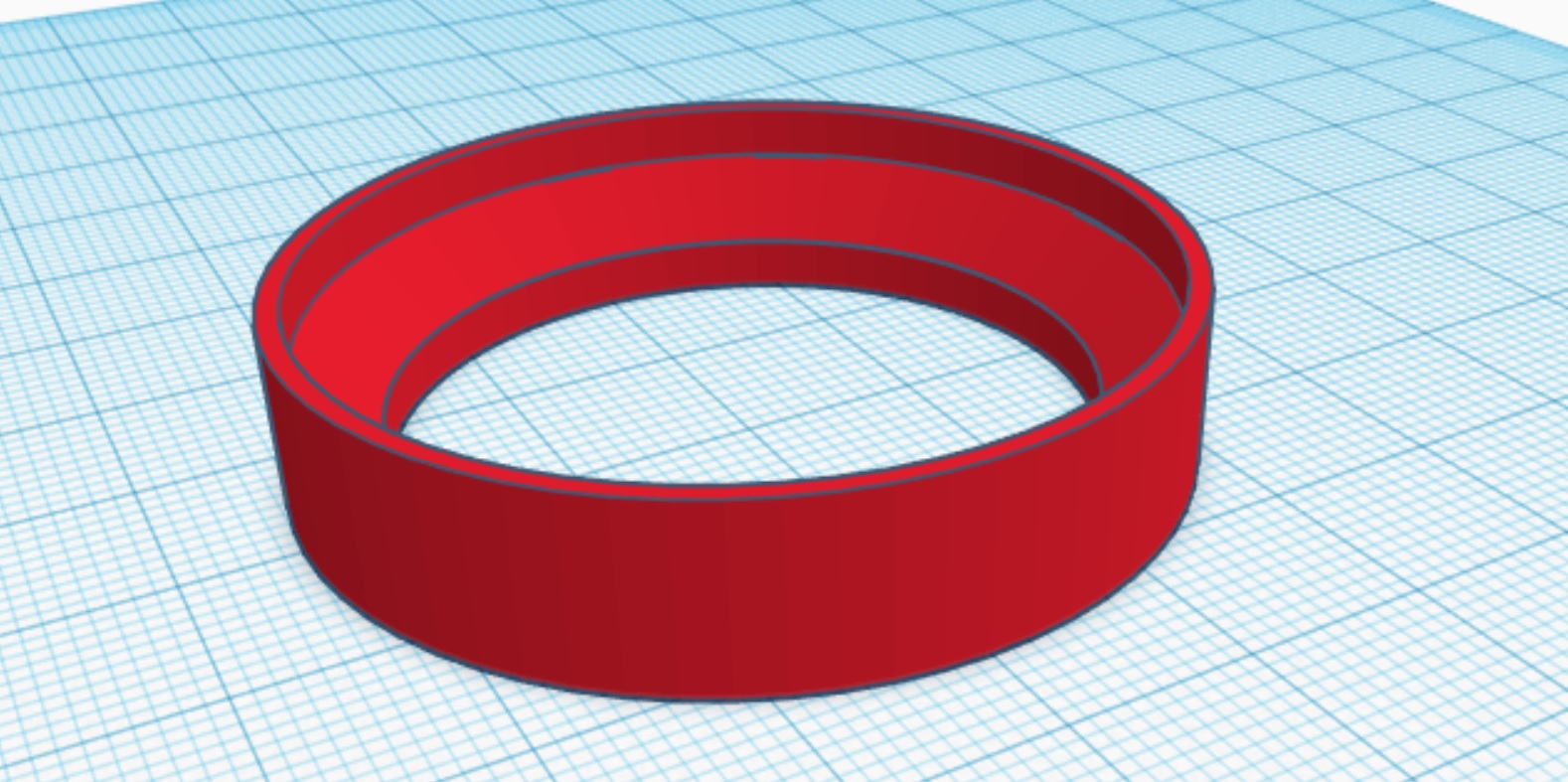
It will be an interesting experiment to see how much I'll gain from it.

Printed the adapter using a SLA resin printer. I changed the design a bit - the "fingers" of the "crown" are used to glue the adapter with silicon sealant to the crystal encapsulation canister.
The tapering portion in the middle was painted with white reflective paint.
Best,
Andrey
Perhaps I can 3D-print a tapered "collar" as an adapter and paint the inside of it with reflective white paint. As you point out - it will serve a dual purpose - negotiate the difference in sizes and reflect light back into the assembly.
just designed this one:
It will be an interesting experiment to see how much I'll gain from it.
Printed the adapter using a SLA resin printer. I changed the design a bit - the "fingers" of the "crown" are used to glue the adapter with silicon sealant to the crystal encapsulation canister.
The tapering portion in the middle was painted with white reflective paint.
Best,
Andrey
