
Difference that detector choice makes when acquiring spectra

Share your spectra and discuss their features here
Post Reply
stamasd
Posts: 102
Joined: 29 Oct 2017, 02:12
Contact:

Difference that detector choice makes when acquiring spectra

Post by stamasd » 03 Aug 2025, 03:32

This a fun little project that I did over the past couple of days.
It started with me building a scintillation detector (which I had all the materials for and just never got around to) and then testing against another detector.
I ended up highlighting some differences between the 2 detectors, which will have consequences in the future on how I use them.

The test subject for this was a rock: a piece of N.O.R.M. that I picked up many years ago during a prospecting trip to Utah. It's 5cm by 4cm by 1cm and registers around 10000cpm on a basic Geiger counter. It contains uranium-bearing minerals.

The test procedure involved acquiring its gamma spectrum using 2 probes, each for 1800s (30 minutes). Background was subtracted from the data; the background spectrum was acquired independently for each detector for 1800s before the test. Energy calibration was done the same way for each detector, using the 2 peaks of 176-Lu from a piece of LYSO, and the 2 peaks of 60-Co from a standard calibration source, and checked against a 137-Cs standard source.

Exhibit 1
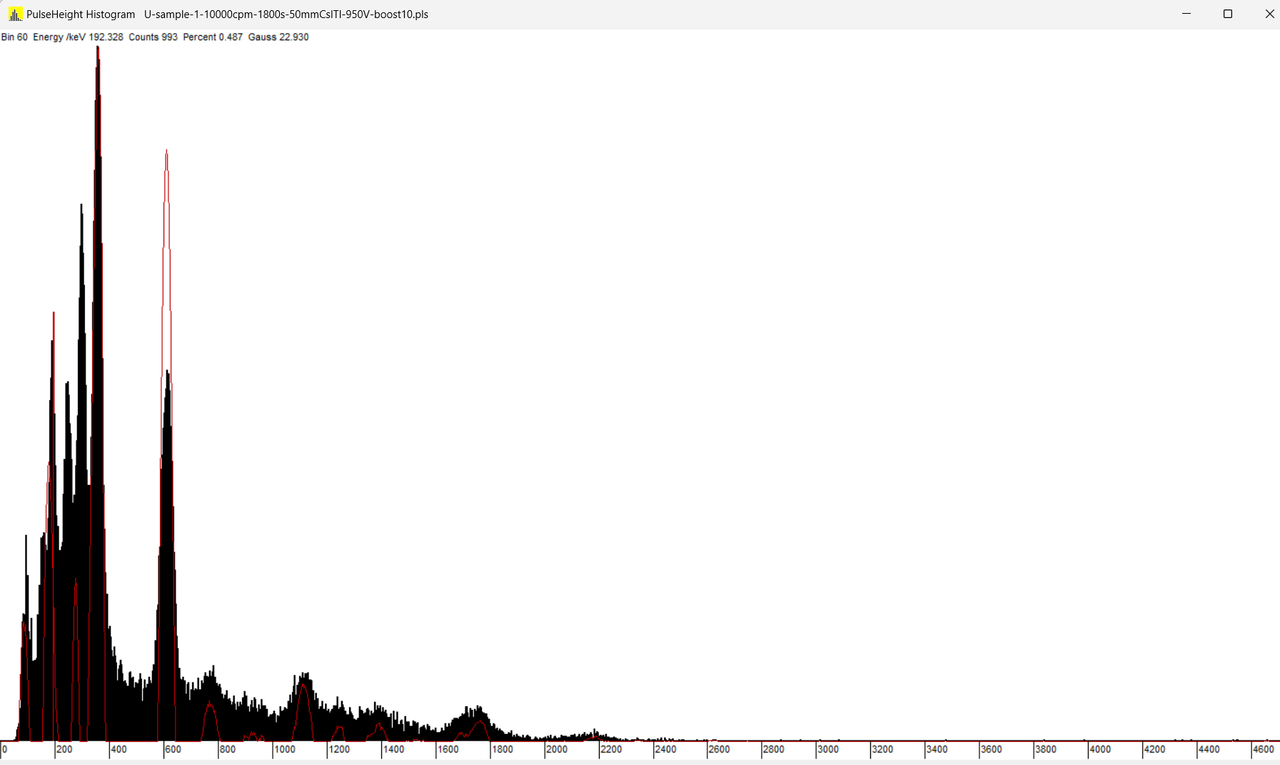
Detector: GS-2020-CSI, 2x2inches CsI(Tl) from Gammaspectacular, operated from a GS-USB-PRO at 950V, acquisition done in PRA at boost gain = 10.
Image

You can see several peaks from the 238-U and 235-U decay chain including
214-Pb at 242 and 352 keV
210-Tl at 210 keV
214-Bi at 609 and 1120keV
228-Ac at 772 keV

Exhibit 2

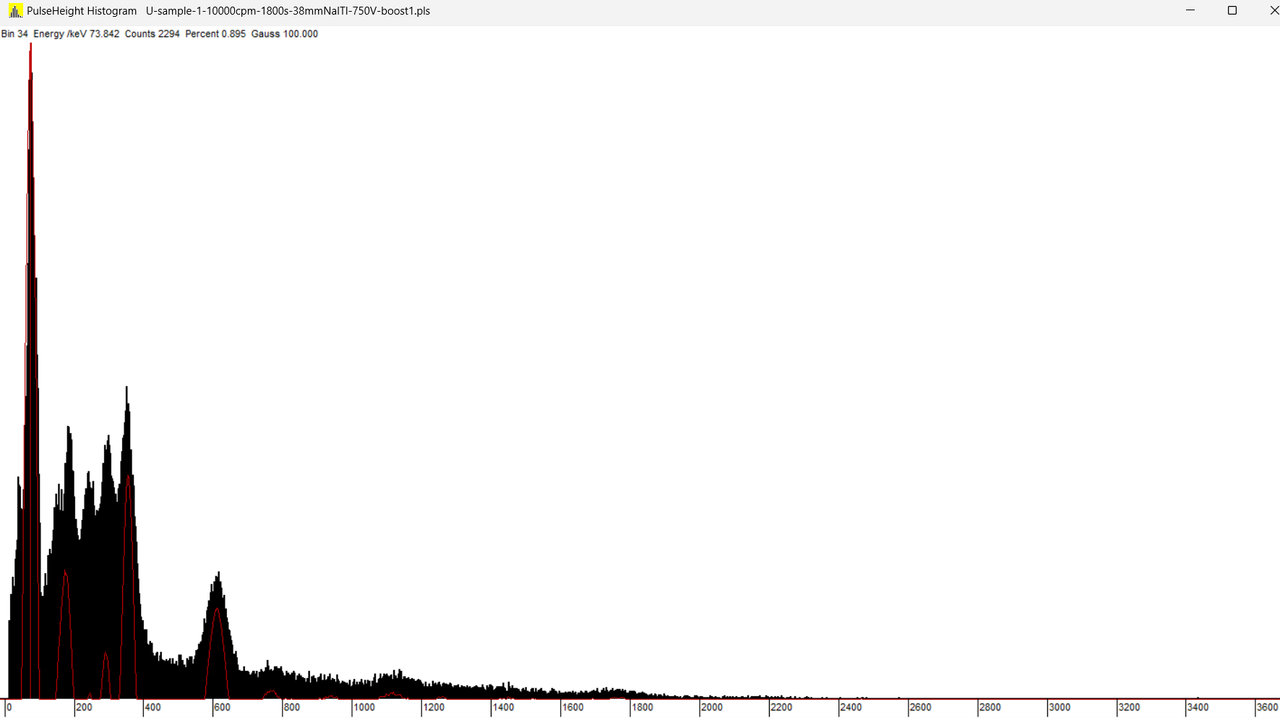
Detector: homebuilt this week from a 1.5" by 2.5" NaI(Tl) crystal, also obtained from Gammaspectacular (XL-NAI-1525) and a Hamamatsu R9420-21 PMT tube which I already had, with appropriate voltage divider installed. This was also operated from the same GS-USB-PRO at 750V, and acquisition was done in PRA with a boost gain of 1. I determined these parameters by several experiments before the test.
Same rock was used as a subject.
Image

You can see the same peaks as above, but in addition the very striking peak at 73 keV which was much less pronounced in exhibit 1. The most likely (in fact almost the only) candidate for that is 234-Pa from the 238-U decay series.
On the other hand, the higher energy peaks are much less pronounced. Also energy resolution seems somewhat better with the CsI detector

Interesting food for thought.
Real name: Silviu Tamasdan

User avatar
Bob-O-Rama
Posts: 22
Joined: 15 Feb 2025, 08:33
Location: Allentown, PA, USA, Earth, Sol, etc.
Contact:

Re: Difference that detector choice makes when acquiring spectra

Post by Bob-O-Rama » 06 Aug 2025, 07:02

It may be you are seeing lower BG rates from the smaller sensor, so the peaks "pop" more?
-- Bob
Bob Mahar
Allentown, PA, USA

User avatar
Sesselmann
Posts: 1374
Joined: 27 Apr 2015, 11:40
Location: Sydney
Contact:

Re: Difference that detector choice makes when acquiring spectra

Post by Sesselmann » 12 Aug 2025, 09:27

Silviu,

Typically CsI(Tl) has better resolution than NaI(Tl), CsI(Tl) is also more consistent whereas NaI(Tl) can vary in quality.

Without seeing how the NaI(Tl) is made it is difficult to determine why the resolution varies from around 6.5% for a good one to 8 % for a not so good one. The lower resolution ones are of course fine for use with a survey meter, but that's not useful to me, so I often end up with a stack of crystals that have resolution > 7.5%

Magnetic shielding makes a difference, earths magnetic field does affect the resolution, you can experiment by placing your detector in different positions with respect to the Earths magnetic field.

Make sure that you wrap the PMT especially the cathode (window end) of the PMT with proper annealed mu metal.

Thanks for posting

Steven

stamasd
Posts: 102
Joined: 29 Oct 2017, 02:12
Contact:

Re: Difference that detector choice makes when acquiring spectra

Post by stamasd » 17 Aug 2025, 09:45

Steven, the self-built detector does have a mu-metal shield. The NaI(Tl) crystal which I got from you was hand-marked "7.1%" so I assume that was the measured FWHM. The crystal and PMT are optically connected with clear silicone oil, secured together with heavy duty electrical tape, the shield is on top of this (and connected to ground = cathode) and externally protected with thick marine-grade heat shrink. Overall I am satisfied with the performance of this detector, it is one of the better ones I built.
Real name: Silviu Tamasdan

Post Reply

Who is online

Users browsing this forum: No registered users and 68 guests