Black sand from a beach in Sithonia, Greece
Posted: 02 Oct 2020, 07:25
I've read some time while ago that black sands are composed of the heavier mineral fractions of vulcanic and/or intrusive rock and may sometimes have elevated levels of radioactivity. And a specific place where I often encounter spots of black sands on the beach is on Sithonia peninsula, Greece (I fell in love with that place and I visit every summer since the first time I went there - it's really, really lovely).
Sithonia is a mountainous peninsula predominantly made of intrusive rocks - granites, diorites and granodiorite - except for the western parts. This means a lot of interesting samples to analyze - although most of the rock samples I've brought back and tested turned out to be rather low activity ones showing a typical thorium spectrum and (interestingly) low in K40 activity - guess the feldspar in granites has low potassium content.
This is the second summer I collect black sand samples from all around the peninsula and I've collected quite a few samples from there - basically every day there we drive to a different location, there are quite a lot of rocky beaches suitable for obtaining both rock and sand samples. It's basically combining the fun of going to a beach with the fun of doing some work for spectrometry purposes :) The previous year though, none of my black sand samples turned out particularily interesting - all of them were very low activity ones.
This summer it certainly got more interesting. That is - the first black sand sample gave out almost 60CPS from just a bit less than 50g of material inside the shield (room background being about 120-130CPS). Interestingly, I recently got some apatite from Brazil (about the same mass) - they were thorium-enriched and still had lower activity. So this black sand has higher activity than apatite, which was rather surprising. Ironically, the only photo I took of the black sand "in situ" was exactly from the location I took the sample - at a beach near the town of Sarti:
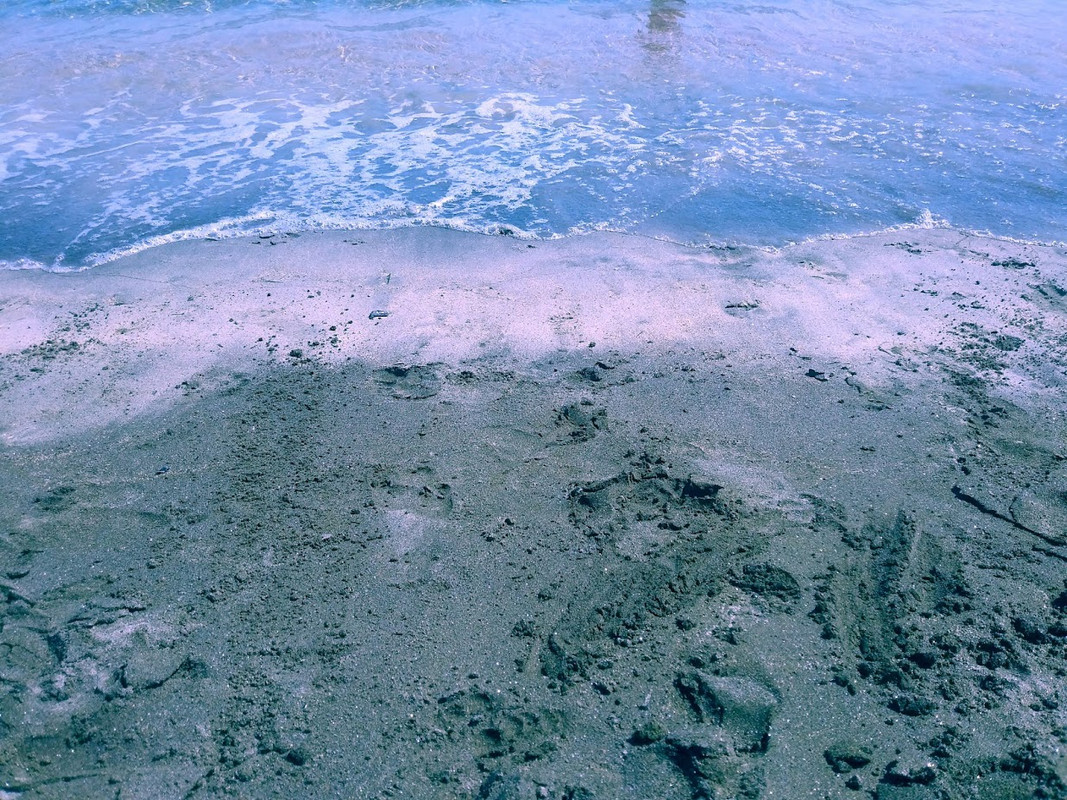
Normally, the black sand is localized at relatively small spots close to or in contact with seawater and forms thin layers, I guess the sea somewhat sorts the heavy minerals in a "mechanical" way. This one in particular was quite a large spot, with a relatively thick layer and had that dark-greenish color. I was suspecting that might be interesting, because....well, it looked somewhat different.
So the spectrum turned out to be a typical Thorium one:
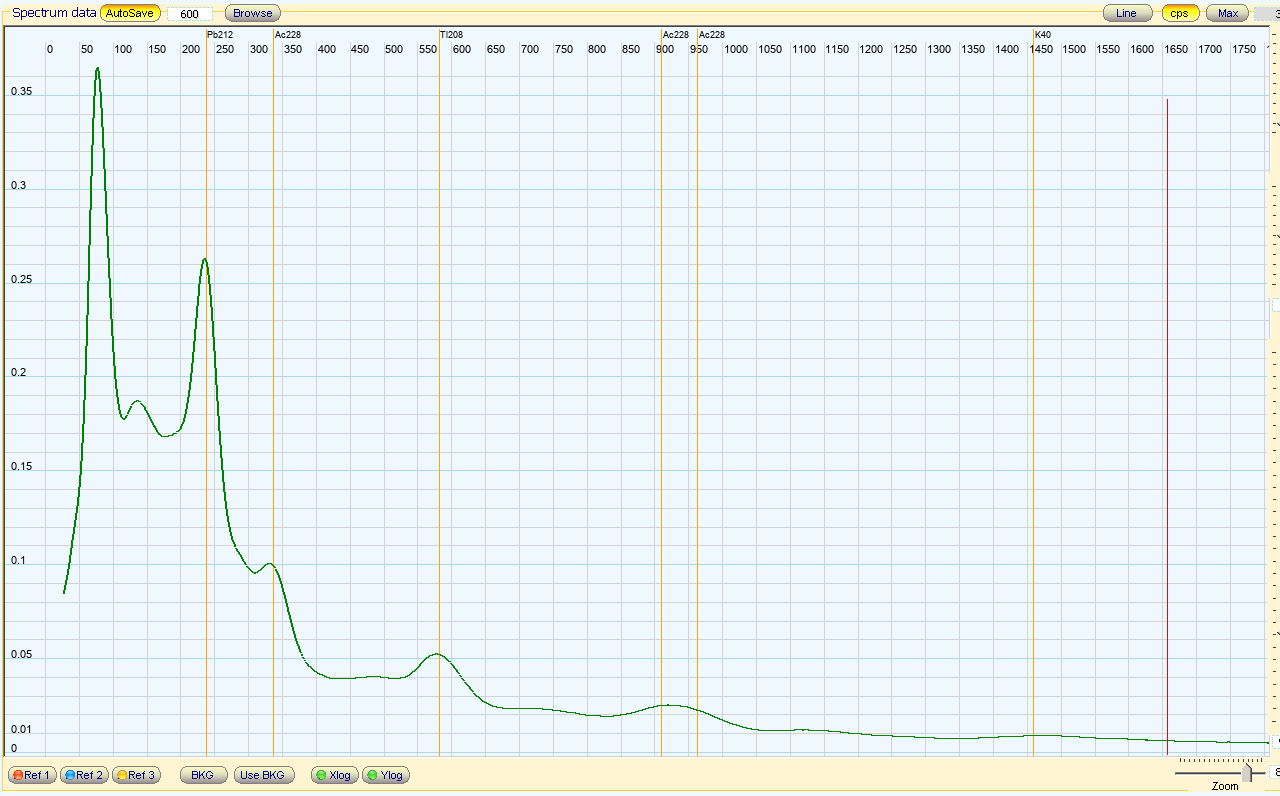
Due to it's relatively high activity, it didn't require neither background extraction, nor a particularily long measurement time, just a couple of hours were quite enough.
Compared to the sand I previously tested from Vromos bay, Bulgaria (where a poorly recultivated copper mine was to blame), that one has like 4 times higher gamma activity. The Vromos sand though was Uranium-enriched, while this one is natural and Thorium and unlike Vromos where practically all the sand is like that, the Sithonian thorium sand is localized in a small spots near the water.
Apparently you don't need to go to India or Brazil for that, Europe has those too :) Well probably not as radioactive as them nevertheless.
Wondering what minerals in the sand are responsible for the thorium. Monazite? Zircon? Who knows...
Sithonia is a mountainous peninsula predominantly made of intrusive rocks - granites, diorites and granodiorite - except for the western parts. This means a lot of interesting samples to analyze - although most of the rock samples I've brought back and tested turned out to be rather low activity ones showing a typical thorium spectrum and (interestingly) low in K40 activity - guess the feldspar in granites has low potassium content.
This is the second summer I collect black sand samples from all around the peninsula and I've collected quite a few samples from there - basically every day there we drive to a different location, there are quite a lot of rocky beaches suitable for obtaining both rock and sand samples. It's basically combining the fun of going to a beach with the fun of doing some work for spectrometry purposes :) The previous year though, none of my black sand samples turned out particularily interesting - all of them were very low activity ones.
This summer it certainly got more interesting. That is - the first black sand sample gave out almost 60CPS from just a bit less than 50g of material inside the shield (room background being about 120-130CPS). Interestingly, I recently got some apatite from Brazil (about the same mass) - they were thorium-enriched and still had lower activity. So this black sand has higher activity than apatite, which was rather surprising. Ironically, the only photo I took of the black sand "in situ" was exactly from the location I took the sample - at a beach near the town of Sarti:
Normally, the black sand is localized at relatively small spots close to or in contact with seawater and forms thin layers, I guess the sea somewhat sorts the heavy minerals in a "mechanical" way. This one in particular was quite a large spot, with a relatively thick layer and had that dark-greenish color. I was suspecting that might be interesting, because....well, it looked somewhat different.
So the spectrum turned out to be a typical Thorium one:
Due to it's relatively high activity, it didn't require neither background extraction, nor a particularily long measurement time, just a couple of hours were quite enough.
Compared to the sand I previously tested from Vromos bay, Bulgaria (where a poorly recultivated copper mine was to blame), that one has like 4 times higher gamma activity. The Vromos sand though was Uranium-enriched, while this one is natural and Thorium and unlike Vromos where practically all the sand is like that, the Sithonian thorium sand is localized in a small spots near the water.
Apparently you don't need to go to India or Brazil for that, Europe has those too :) Well probably not as radioactive as them nevertheless.
Wondering what minerals in the sand are responsible for the thorium. Monazite? Zircon? Who knows...