A Tale of Triple Trinitite
A friend bought some Trinitite off Ebay and I said it would be fun to run a gamma spec on it to see if I could pick off any fission product isotopes. I sure could! It was so cool that I decided to buy some for myself, though from a different source. My two samples also have characteristic markers, but not quite as interesting as his.
I've started giving all samples designators so I can keep track of everything.
JC-TR-01
From friend. About 32mm across, just under 4g. Nice spectrum with Cs-137, Am-241, and Eu-152 all showing clear peaks. Pancake probe gives 260 CPM over background. Purchased on eBay (seller unknown).
MS-TR-01
Small sample with some "red" coloring. Purchased from the Atomic Rock Shop. Listed as 1.395g. about 160 CPM over background using a pancake probe. Very weak, will need a long run in a good shield to show anything interesting.
MS-TR-02
Larger and more glassy than MS-TN-01, physically more similar to JC-TN-01, but slightly smaller. Seller lists as 3.329g. 610 CPM over background with a pancake probe. Spectrum is strong in Cs137 and Am241, but Eu152 is much weaker than JC-TR-01.
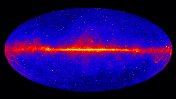
The attached spectrum shows all three plotted in CPS on the same scale. Note that JC-TR-01 was done first and substantial improvements were made to the shield before testing the other samples. MS-TR-01 only had a 7 hour run because it wasn't getting that interesting and I wanted to move on to MS-TR-02. I still have more shield improvements planned, so I will retest at a later time. Even though background subtraction wasn't used for the comparison plot, I did show the background spectrum taken in the shield as used for MS-TR-01/02.
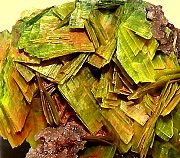
The three samples. US quarter for size comparison (sorry, no euro handy).
I'll also attach plots of MS-TR-02 with the full spectrum and with background subtraction.
Mike S.
I've started giving all samples designators so I can keep track of everything.
JC-TR-01
From friend. About 32mm across, just under 4g. Nice spectrum with Cs-137, Am-241, and Eu-152 all showing clear peaks. Pancake probe gives 260 CPM over background. Purchased on eBay (seller unknown).
MS-TR-01
Small sample with some "red" coloring. Purchased from the Atomic Rock Shop. Listed as 1.395g. about 160 CPM over background using a pancake probe. Very weak, will need a long run in a good shield to show anything interesting.
MS-TR-02
Larger and more glassy than MS-TN-01, physically more similar to JC-TN-01, but slightly smaller. Seller lists as 3.329g. 610 CPM over background with a pancake probe. Spectrum is strong in Cs137 and Am241, but Eu152 is much weaker than JC-TR-01.
The attached spectrum shows all three plotted in CPS on the same scale. Note that JC-TR-01 was done first and substantial improvements were made to the shield before testing the other samples. MS-TR-01 only had a 7 hour run because it wasn't getting that interesting and I wanted to move on to MS-TR-02. I still have more shield improvements planned, so I will retest at a later time. Even though background subtraction wasn't used for the comparison plot, I did show the background spectrum taken in the shield as used for MS-TR-01/02.
The three samples. US quarter for size comparison (sorry, no euro handy).
I'll also attach plots of MS-TR-02 with the full spectrum and with background subtraction.
Mike S.
Mike Sullivan
Central Coast of California, USA
Re: A Tale of Triple Trinitite
Trinitite is always great to test, I found so much variety from one sample to the othee that I never really know what to expect before starting with a new one.
I'd like to ask a few questions to understand the results better:
Can you share some detail about your shielding setup?
How many CPS your samples were giving you during the gamma spectrum acquisition and how much CPS is your tipical shielded and unshielded background with that detector?
Is the taller curve in the last picture the sample+background spectrum recorded inside the shield?
Sorry for all the questions!
Massimo
I'd like to ask a few questions to understand the results better:
Can you share some detail about your shielding setup?
How many CPS your samples were giving you during the gamma spectrum acquisition and how much CPS is your tipical shielded and unshielded background with that detector?
Is the taller curve in the last picture the sample+background spectrum recorded inside the shield?
Sorry for all the questions!
Massimo
Re: A Tale of Triple Trinitite
Questions are great!
I have a thread about my shield upgrade project, this post shows my current setup: viewtopic.php?f=10&t=805#p3777
Normal unshielded background is 125 cps with my detector. My early shield (used for JC-TR-01) got that down to about 25 cps. In the current version of the shield I get about 18 cps. Additional counts from the samples:
JC-TR-01 ~7cps
MS-TR-01 ~1 cps
MS-TR-02 ~4 cps
The taller curve in the last picture is the more active sample (JC-TR-01) and done in the older shield. All of the curves in the last picture are sample + background (except the actual background), no background subtraction was done for any of the 3 sources in the last picture.
Mike S.
I have a thread about my shield upgrade project, this post shows my current setup: viewtopic.php?f=10&t=805#p3777
Normal unshielded background is 125 cps with my detector. My early shield (used for JC-TR-01) got that down to about 25 cps. In the current version of the shield I get about 18 cps. Additional counts from the samples:
JC-TR-01 ~7cps
MS-TR-01 ~1 cps
MS-TR-02 ~4 cps
The taller curve in the last picture is the more active sample (JC-TR-01) and done in the older shield. All of the curves in the last picture are sample + background (except the actual background), no background subtraction was done for any of the 3 sources in the last picture.
Mike S.
Mike Sullivan
Central Coast of California, USA
Re: A Tale of Triple Trinitite
Thank you Mike!Mike S wrote: ↑24 May 2020, 19:21Questions are great!
I have a thread about my shield upgrade project, this post shows my current setup: viewtopic.php?f=10&t=805#p3777
Normal unshielded background is 125 cps with my detector. My early shield (used for JC-TR-01) got that down to about 25 cps. In the current version of the shield I get about 18 cps. Additional counts from the samples:
JC-TR-01 ~7cps
MS-TR-01 ~1 cps
MS-TR-02 ~4 cps
The taller curve in the last picture is the more active sample (JC-TR-01) and done in the older shield. All of the curves in the last picture are sample + background (except the actual background), no background subtraction was done for any of the 3 sources in the last picture.
Mike S.
So the more active sample gave you about 40% of your shielded background, that's better than I could manage so far with my current setup, my shielding improvement is overdue.
If I were you I would give another try with background subtraction to JC-TR-01 in particular. Hope your friend won't mind, it's for science :)
Massimo
Re: A Tale of Triple Trinitite
Mike,
What is nice about Trinitite is that it is so challenging you can revisit again and again as your hardware and technique improve.
FYI, if you haven't found it already, the Gamma Spectroscopy iogroup has a Files folder for Trinitite with a nice collection of technical papers.
What is nice about Trinitite is that it is so challenging you can revisit again and again as your hardware and technique improve.
FYI, if you haven't found it already, the Gamma Spectroscopy iogroup has a Files folder for Trinitite with a nice collection of technical papers.
Michael Loughlin
Re: A Tale of Triple Trinitite
Those are some nice clean spectra for such a low activity!
I'm a bit jealous of your results, as my shielding still isn't finished (I don't have much time now, but I'm working on it!)
I haven't got any Trinitite samples yet, but I have an interesting piece of burned concrete from Hiroshima. It's too weak for my current setup, but I hope that with improved shielding, I'll be able to get a better reading.
BTW, isn't it better to use the "IIR Filter" and just set it to zero? If you set it to 0, it can make your peaks "smoother" without distorting the spectrum too much (although sometimes it might not be worth it)...
-Pavel
I'm a bit jealous of your results, as my shielding still isn't finished (I don't have much time now, but I'm working on it!)
I haven't got any Trinitite samples yet, but I have an interesting piece of burned concrete from Hiroshima. It's too weak for my current setup, but I hope that with improved shielding, I'll be able to get a better reading.
BTW, isn't it better to use the "IIR Filter" and just set it to zero? If you set it to 0, it can make your peaks "smoother" without distorting the spectrum too much (although sometimes it might not be worth it)...
-Pavel
Location: Czech Republic
Equipment:
Equipment:
- Spectrometer: Scintillix SCGS-01 v3.0
- Probe: Scintillix 2.5" with 3" PMT
Re: A Tale of Triple Trinitite
Due to the many suggestions for trinitite, I measured my large piece again. But this time with front and back to the scintillator.
As can be seen in the spectrogram, the green side in the low energy range is somewhat stronger than the gray side. The red line points to the scintillator. Gray line is the underground ( BKG ).
Peter
Re: A Tale of Triple Trinitite
Thanks everyone for all the suggestions and encouragement!
Peter, that is a stunning piece you have.
I did a little reasearch and it appears the "red" on one of my samples is probably rust from when the material was stored in metal drums after collection. I've seen a picture of real red inclusions and they are more brick red or brighter.
I'm going to see if I can get a copy of William Kolb's "Trinitite" book. It's not easy to buy; it appears you have to email him directly and he prints on demand.
I have another, larger, specimen on the way from yet a different seller. Additional lead is here for adding more shielding. Looks like more testing in in my future.
Mike S.
Peter, that is a stunning piece you have.
I did a little reasearch and it appears the "red" on one of my samples is probably rust from when the material was stored in metal drums after collection. I've seen a picture of real red inclusions and they are more brick red or brighter.
I'm going to see if I can get a copy of William Kolb's "Trinitite" book. It's not easy to buy; it appears you have to email him directly and he prints on demand.
I have another, larger, specimen on the way from yet a different seller. Additional lead is here for adding more shielding. Looks like more testing in in my future.
Mike S.
Mike Sullivan
Central Coast of California, USA
Re: A Tale of Triple Trinitite
Updates:
The Trinitite book by William Kolb is well worth the cost (at least to me). It's a bit harder to get than going on Amazon, but it's also nice to be able to buy direct from the author (email him at syntec@verizon.net ).
I bought another sample (designation MS-TR-03) that was the hottest I've tested so far. It was easy to generate a spectrum, but it's otherwise pretty typical.
I re-tested JC-TR-01, which was the most interesting in previous testing, and I was getting frustrated with the low end calibration. It seemed to shift and I thought it was my well-used Ludlum 44-10 detector. I bought another, more appropriate detector (Bicron 1.5x2.25) and ran into the same problem. With the new detector in my upgraded shield, I did a pre-calibration using Cs-137 and Am-241, ran the sample for 7 days, and did a post-run confirmation of the calibration. It wasn't dead-on, but darn close considering temperature differences. In previous runs for this sample I had really stretched the Energy Linearizer to make the peak line up with the x-rays from Cs and Am. I now believe that the sample has a large (and real) peak about 40 keV. I can't figure out what might cause that peak. I'm guessing it's an x-ray given the energy, but I can't find any example Trinitite spectra that show that peak. Of course, it could easily be something I'm still doing wrong.
I still have a lot to learn, but it's fun and interesting.
Mike s.
The Trinitite book by William Kolb is well worth the cost (at least to me). It's a bit harder to get than going on Amazon, but it's also nice to be able to buy direct from the author (email him at syntec@verizon.net ).
I bought another sample (designation MS-TR-03) that was the hottest I've tested so far. It was easy to generate a spectrum, but it's otherwise pretty typical.
I re-tested JC-TR-01, which was the most interesting in previous testing, and I was getting frustrated with the low end calibration. It seemed to shift and I thought it was my well-used Ludlum 44-10 detector. I bought another, more appropriate detector (Bicron 1.5x2.25) and ran into the same problem. With the new detector in my upgraded shield, I did a pre-calibration using Cs-137 and Am-241, ran the sample for 7 days, and did a post-run confirmation of the calibration. It wasn't dead-on, but darn close considering temperature differences. In previous runs for this sample I had really stretched the Energy Linearizer to make the peak line up with the x-rays from Cs and Am. I now believe that the sample has a large (and real) peak about 40 keV. I can't figure out what might cause that peak. I'm guessing it's an x-ray given the energy, but I can't find any example Trinitite spectra that show that peak. Of course, it could easily be something I'm still doing wrong.
I still have a lot to learn, but it's fun and interesting.
Mike s.
Mike Sullivan
Central Coast of California, USA
Re: A Tale of Triple Trinitite
Mike S.
Got Plutonium? I have been interested in that peak near 40 for awhile. It is in Massimo's spectrums as well. The Pitteaurova paper (link and HPGe spectrum below) describes it as a combination of Sm K alpha1 x-rays (40.12 keV) and Plutonium 239 (38.7 keV). I think it lines up better at 39 than 40 in my spectrums, but it is really difficult to say.
I have a "Green" friend who was horrified at the thought of my possession of Trinitite samples because of the toxicity of Plutonium. I didn't know how to evaluate or address his concerns other than promise to handle it carefully and never to eat any of it...
https://pdfs.semanticscholar.org/ea58/a ... 1577197316
Got Plutonium? I have been interested in that peak near 40 for awhile. It is in Massimo's spectrums as well. The Pitteaurova paper (link and HPGe spectrum below) describes it as a combination of Sm K alpha1 x-rays (40.12 keV) and Plutonium 239 (38.7 keV). I think it lines up better at 39 than 40 in my spectrums, but it is really difficult to say.
I have a "Green" friend who was horrified at the thought of my possession of Trinitite samples because of the toxicity of Plutonium. I didn't know how to evaluate or address his concerns other than promise to handle it carefully and never to eat any of it...
https://pdfs.semanticscholar.org/ea58/a ... 1577197316
- Attachments
-
- Pu239.xlsx
- (23.86 KiB) Downloaded 443 times
Michael Loughlin
Who is online
Users browsing this forum: Bing [Bot] and 12 guests